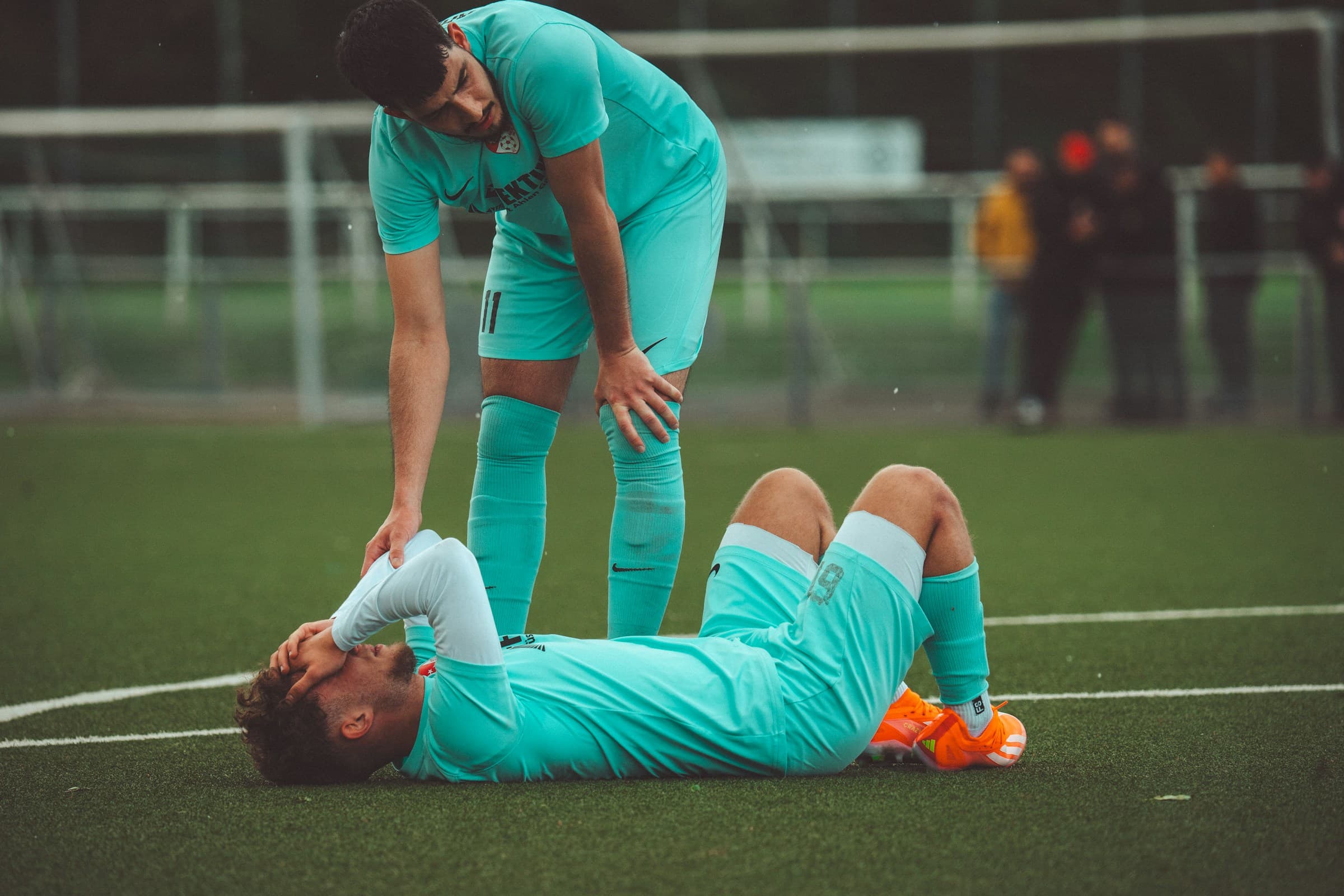
A Sunday morning junior B league game, twenty minutes in. The corner forward breaks clear, opens up for the last ten metres, and pulls up holding the back of his thigh. He is frustrated before he is worried, and the first thing he wants to know is how many weeks he will miss.
The first injury is usually not the expensive one. In 21 seasons of the UEFA Elite Club Injury Study, around 18 percent of hamstring injuries were repeats, and more than two thirds of those came within two months of the player returning. So if you are reading this with a sore hamstring, it is worth asking yourself early: is this the first time, or the second?
Where it tears
The hamstrings run from the sitting bone at the base of the pelvis to just below the knee. In running they brake the lower leg as it swings forward, in the split second before the foot lands. At full speed the muscle is being stretched while it works hardest, and that is where most injuries happen.
Most of the damage lands on biceps femoris, the outer hamstring. In a UEFA study of 255 hamstring injuries in professional football, 84 percent were to that one muscle. A rarer type comes from slow, extreme stretching such as a high kick. Swedish research on dancers found these sat close to the tendon at the sitting bone and took far longer to recover from.
Who gets them
Anyone who sprints. Hamstring injuries made up 24 percent of all injuries in the latest season of the UEFA study, double the share twenty years earlier. A four-year study of county-level Gaelic football found they were its single most common injury, almost a quarter of the total.
A 2020 review of 78 studies found older age and a previous hamstring injury were the strongest risk factors. A recent one raised the risk of another almost fivefold.
What gets people back sooner
For most hamstring injuries, treatment is rehabilitation led by a physiotherapist. The question is what goes into it.
A Swedish trial of 75 elite footballers changed the picture. Players whose rehabilitation focused on loading the hamstrings in lengthened positions were back in full training after 28 days on average. Players on a conventional programme took 51. It is one trial, in elite Swedish footballers, and nobody has shown the same gap in a 45-year-old who runs parkrun in the Phoenix Park. The direction of the finding is widely accepted. The size of the gap for ordinary players is not known.
Injections have done less well than their reputation. A double-blind Dutch trial in the New England Journal of Medicine found platelet-rich plasma (PRP) injections no better than placebo, both for time to return and for reinjury a year later. A second trial, in professional athletes in Qatar, found no benefit of PRP over intensive physiotherapy-led rehabilitation.
The exception is a tendon that has pulled away from the sitting bone. That needs a surgeon's opinion, and studies of surgical repair suggest outcomes tend to be better when the repair happens early.
Do you need a scan?
Usually not. Players and coaches want a return date on day one, and clinicians, physios included, often reach for a scan to give one. The evidence does not back that up. A systematic review found no strong evidence that any MRI finding predicts how long recovery will take. A Dutch study went further: what the scan showed at the start did not predict who would be injured again, but clinical tests done just after returning to play did. A scan earns its place when a tendon injury near the sitting bone is suspected.
How long it takes
Population studies give a range, not an answer. In professional football, average time out ran from about 8 days for the mildest injuries to more than 70 for the most severe. Those are professionals with full-time medical staff, and individuals vary widely within any group.
The more useful marker is not the calendar. It is whether strength and the ability to sprint have come back, compared with the other leg and with what your sport asks of you. The reinjury figures above are what happens when the pain settles and people go back before that.
Prevention
A 2019 analysis of 15 studies and 8,459 athletes found prevention programmes that include the Nordic hamstring exercise roughly halved the rate of hamstring injuries, in women and men across several sports. It is also widely ignored. The same review found that teams have been slow to adopt the exercise into regular training, and a programme only works if a squad keeps doing it through the season.
Why video suits hamstring rehabilitation
Hamstring rehabilitation is weeks of progressive loading on the pitch and in the gym. The physiotherapist sets the load for your stage, corrects technique and moves the plan on. Very little of that needs a treatment table. A 2024 systematic review in the Journal of Physiotherapy found attendance and exercise adherence were both higher with telehealth than in person, and an earlier meta-analysis found video physiotherapy for musculoskeletal problems comparable to face-to-face care.
The honest limit: a physiotherapist cannot press on the sore spot through a screen, and where the tenderness sits is part of assessing a hamstring injury. Where hands-on assessment or a scan is needed, a good online physiotherapist will say so.
When to see someone else first
The HSE's sprains and strains page says when to go to a minor injury unit or emergency department, for example if you heard a crack, or the leg is numb, cold or out of shape. If the injury was severe, is getting worse, or you are not sure what it is, see your GP first. A physiotherapist will ask about these things at the start of a session too.
Hamstring injuries in Ireland
The wait for a public physiotherapy assessment is often long. Private physiotherapy in Ireland typically costs between EUR 50 and EUR 75 a session in person. Many health insurance plans refund part of the cost with a CORU-registered physiotherapist. Check your own policy and the Revenue guidance, because the rules vary.
How Book a Physio fits
Book a Physio connects you with CORU-registered physiotherapists for 30 minute video sessions at a fixed price.